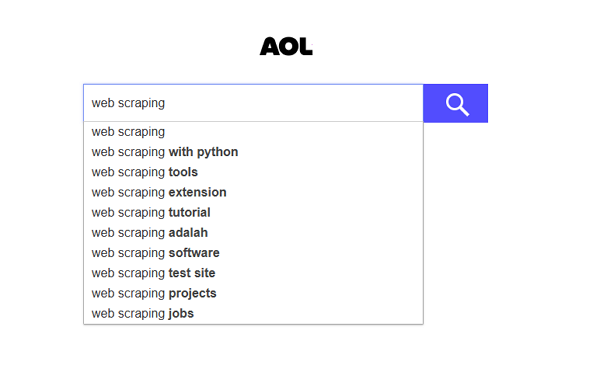


Bing results look easy to copy until the work expands beyond one query. The moment you need a repeatable schedule, clean columns, or several pages of results, manual copying becomes the slowest part of the research. In 2026, the practical routes are a ready-made Octoparse template for the fastest export, Octoparse API or MCP for repeatable workflows, Octoparse Desktop when the fields and pagination need careful control, and Python or a third-party SERP service for code-first projects.
One important change shapes this choice: Microsoft retired the Bing Search APIs on August 11, 2025. They are no longer a general-purpose route for collecting search results. This guide therefore focuses on methods that still make sense today, including a documented test of the Bing Search Results Scraper template.
https://www.octoparse.com/template/bing-search-results-scraper
What Does It Mean to Scrape Bing Search Results?
Scraping Bing search results means turning the visible result page into structured rows. A basic dataset usually contains the query, result title, destination URL, description, and source. A custom workflow can also separate sponsored listings from organic results, record positions, capture related questions, or follow a result into its destination page.
This is different from a web crawler that discovers pages by following links across a site. It is also different from Bingbot, the crawler Microsoft uses for its own search index. Here, the target is a known search results page and the objective is a consistent table that can be reviewed, compared, and exported.
Four Ways to Scrape Bing, from Easiest to Most Flexible
Bing scraping methods compared
| Best for | Main limitation | |||
|---|---|---|---|---|
| Fast, no-code keyword exports | Inputs and output fields are defined by the template | |||
| Scheduled pipelines, agents, and repeatable jobs | Automates supported Octoparse templates or tasks; it is not a Bing API | |||
| Custom fields, pagination, filtering, and resilient workflows | Needs more setup and testing than a prepared template | |||
| Code-first products and custom processing | Selectors, blocking, maintenance, and service costs remain your responsibility |
The order is intentional. Start with the smallest tool that can answer the question. Move to automation when the same workflow must run again, and move to the Desktop client when control matters more than speed of setup.
Method 1: Use the Bing Search Results Scraper Template
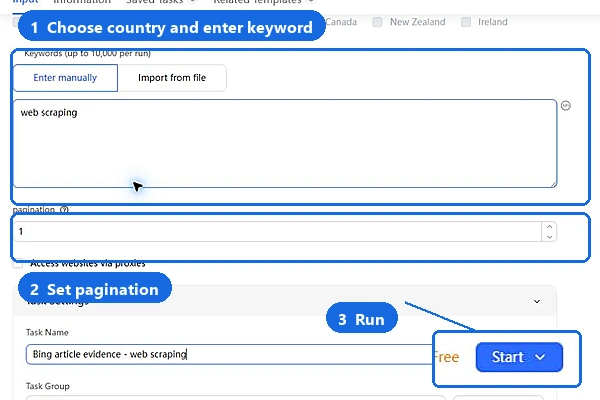
For readers looking for a practical Bing scraper, the template is the shortest route from a keyword to a spreadsheet. It runs in a web browser or the Octoparse app, requires no selector building, and accepts language, country or area, keywords, and pagination as inputs. At the time of testing, the page allowed up to 10,000 keywords per run; practical limits still depend on the current template, account plan, and target behavior.
Step 1: Choose the market and enter a keyword
Select the language and country that match the market you want to observe. Enter one keyword per line, set the number of result pages, and give the task a clear name. For this test, the settings were English, United States, web scraping, and one page.
Step 2: Run the task and inspect the data
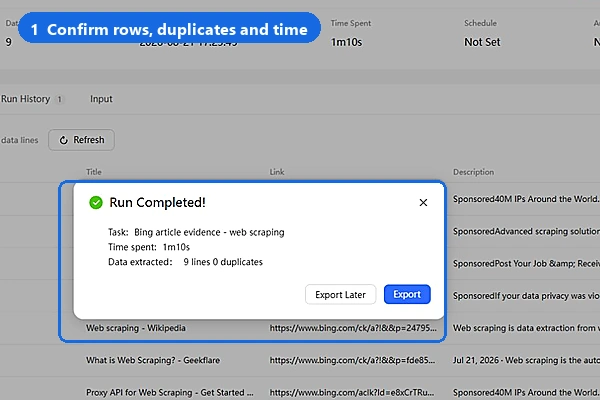
Choose the web browser run mode for a quick cloud test. When the task finishes, do not jump straight to export. Check the row count, duplicates, column names, empty cells, and whether sponsored listings are mixed with organic results.
What the live test returned
The run completed on August 21, 2026 in 1 minute 10 seconds. It returned 9 rows and reported 0 duplicates. The exported columns were Keyword, Title, Link, Description, and Source. The CSV file contained the same 9 rows.
Evidence note: this is one reproducible test, not a guaranteed benchmark. Bing returned both sponsored and organic results, and several sponsored rows had an empty
Linkfield. Result volume, timing, and field completeness can change with the query, market, page layout, and run conditions.
Step 3: Export the checked result
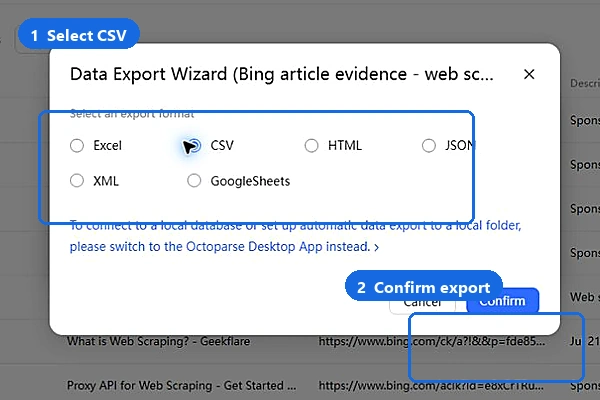
After reviewing the table, select Export Data, choose CSV, and confirm. Octoparse prepares the file in My Datasets rather than presenting an instant browser download.
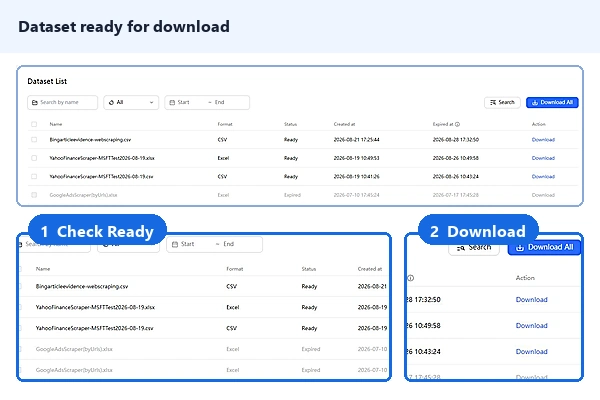
Wait until the status changes to Ready, then download the file. In this test the export record was named Bingarticleevidence-webscraping.csv, contained 9 rows, and was 9,239 bytes on disk.
Template output fields
| Meaning | Quality check | |
|---|---|---|
| The input query associated with the row | Confirm it matches the requested market and spelling | |
| The visible result headline | Check for ads, truncation, or missing text | |
| The captured destination or Bing tracking URL | Validate empty values and redirect URLs before downstream use | |
| The visible result snippet | Expect wording and availability to vary by result type | |
| The visible publisher or source name | Do not assume it is present or normalized for every row |
Ready to test your own Bing query? Start with one keyword, inspect the fields, and scale only after the first page looks right.
https://www.octoparse.com/template/bing-search-results-scraper
Method 2: Automate Existing Workflows with Octoparse API or MCP
Once a template or task is producing reliable data, the next step is usually automation rather than rebuilding the extractor. The Octoparse API is the code-oriented path: an application can find tasks, start a cloud run, check status, and retrieve data. Octoparse MCP exposes supported template and task actions to compatible AI clients, allowing a user to request a run and inspect the result through natural language.
Neither one is a replacement Bing API. They are control layers for Octoparse workflows. The extraction definition still comes from a supported template or a cloud task, and a production pipeline should validate the task ID, terminal run status, row count, schema, and export artifact before accepting the result.
- Choose API when code, a scheduler, n8n, Make, or an internal application needs deterministic control.
- Choose MCP when a supported AI client should discover or run an existing Octoparse workflow conversationally.
- Keep secrets out of prompts and screenshots. Store API keys in a secret manager or environment variable, and rotate a key if it is ever exposed.
Need the same Bing dataset every week? Automate only after the task returns the fields you expect, then let your application start runs and collect the checked output.
Method 3: Build a More Reliable Workflow in Octoparse Desktop
The Desktop client is the better choice when a prepared template returns almost what you need but not quite. A Custom Task lets you select fields in the built-in browser, inspect the generated workflow, rename or remove columns, test pagination, and run locally or in the cloud.
This extra control matters on search pages. You can separate sponsored blocks from organic results, keep an explicit position field, normalize tracking URLs, add waits, and test what happens when a result has no description. It takes longer to configure, but it is usually the most stable and accurate Octoparse route for a business dataset whose schema must remain understandable.
Need fields the template does not return? Build the selectors, pagination, and validation around the dataset you actually need instead of forcing a prepared workflow to fit.
Method 4: Scrape Bing with Python
Python is useful when extraction is only one step inside a larger application. A minimal request-and-parse example can collect the standard organic cards, but it is best treated as a starting point rather than a durable scraper. Search markup changes, localized layouts differ, and repeated requests may be throttled or challenged.
Before using code at scale, add respectful delays, retries with limits, logging, schema checks, and a stop condition. Verify Bing’s current terms and applicable law for your use case. If you would rather buy a maintained interface, compare third-party SERP services on supported markets, data provenance, freshness, rate limits, retention, and total cost—not only the advertised price per request.
How to Choose the Right Method
- One-off keyword research: start with the template and export CSV or Excel.
- Recurring monitoring: validate a template or task first, then connect it through Octoparse API or MCP.
- Custom SERP schema: use Desktop when you need position, result type, pagination logic, or URL cleanup.
- Product engineering: use Python or a maintained SERP service when the data must flow directly into application code.
If your research spans more than one search engine, compare the differences rather than forcing every page into the same assumptions. Octoparse also has guides for Google search results and DuckDuckGo data.
Responsible Collection and Quality Checks
Search results are public-facing, but that does not remove every obligation. Collect only what the project needs, respect access rules and reasonable request rates, avoid bypassing authentication or technical controls, and review personal or sensitive data before storage. For commercial or regulated use, involve legal and security reviewers early.
Quality deserves the same attention. Save the input query, language, country, collection time, method, and page count beside the results. Check a sample against the live page, distinguish ads from organic listings, test links, and record empty fields. A dataset that cannot explain how it was produced is difficult to trust later.
Frequently Asked Questions
- Does Bing still offer a Search API?
No general Bing Search API is available as the old product was retired on August 11, 2025. Microsoft points Azure customers toward Grounding with Bing Search for agent grounding, which is a different product and use case.
- Is the Bing Image Search API still available?
No. The former Bing Image Search API was part of Microsoft’s Bing Search API family, which was fully retired on August 11, 2025. Microsoft now directs Azure customers to Grounding with Bing Search for supported agent-grounding scenarios; it is not a drop-in image search API. If the goal is to collect visible image-result data, use a compliant browser-based extraction workflow and validate its fields against the live result page.
- Can I export Bing search results to Excel?
Yes. The Octoparse template can export supported results in formats including CSV and Excel. Inspect the data first, because the visible result type influences which fields are populated.
- What is the difference between the Octoparse template, API, and MCP?
The template defines a ready-made extraction workflow. The API lets code control supported Octoparse tasks and retrieve their data. MCP lets compatible AI clients interact with supported Octoparse workflows. API and MCP automate Octoparse; they do not call a hidden Bing API.
- Why did the test return fewer than ten rows?
A search page is not a fixed database response. Market, query, ads, page layout, deduplication, and extraction rules all affect the row count. The tested configuration returned 9 rows for one page; another query may return a different number.
- Is it legal to scrape Bing search results?
Legality depends on the data, jurisdiction, access method, and intended use. Public visibility alone is not a complete legal analysis. Follow current site terms, avoid circumvention, limit collection, and seek legal advice for sensitive or commercial projects.
- Which method is the most stable?
For a defined custom dataset, Octoparse Desktop usually offers the most control because you can inspect and adjust the workflow. For the fastest standard export, the template is easier. Stability still depends on testing, target changes, and ongoing validation.
A Practical Starting Point
Begin with one representative keyword and one page. Run the template, inspect the output, and save the CSV only after the schema looks right. If the same question returns next week, automate the verified workflow with API or MCP. If the standard fields are not enough, move into Octoparse Desktop and build the extraction you actually need.